
Part of Something Bigger
UNITED LABOR UNIONS LOCAL 100 IS PROUD TO STAND WITH ARKANSAS WORKERS

This is the first issue of a newsletter for members of United Labor Unions Local 100, City of Little Rock workers, State of Arkansas employees, University of Arkansas for Medical Sciences (UAMS), and Central Arkansas Library System staff. This union exists because working people across our city are stronger standing together.
For our City of Little Rock members, this past year brought real gains. Local 100 has pushed for fair compensation and better working conditions for municipal employees, and that work is paying off.
Local 100 isn’t new to this work. Founded in 1980 in New Orleans by Hyatt hotel and Tulane University workers, the union proved organizing could win in the South.
After affiliating with SEIU in 1984, Local 100 organized school support staff across Louisiana, healthcare workers in Arkansas and Louisiana hospitals, and Head Start workers across Texas, Louisiana, and Arkansas.
In 2009, Local 100 became independent again, giving members direct control of their union.
Today we represent workers across Louisiana, Arkansas, Texas, and Mississippi, and remain connected to ACORN International, part of a global network of community organizations.
Our reach extends to the airwaves too. Local 100 is a proud partner of KABF 88.3 FM, “The Voice of the People,” a 100,000-watt community radio station broadcasting across Arkansas since 1984.
Our Field Director, Toney Orr, currently chairs KABF’s board, giving our members a real platform to be heard.
Whether you work for the City, CALS, the State of Arkansas, or UAMS, you’re joining a union with decades of experience winning for working people.
Welcome to the first issue.
The Librarians are Organizing!
CALS STAFF ACROSS CENTRAL ARKANSAS JOIN LOCAL 100
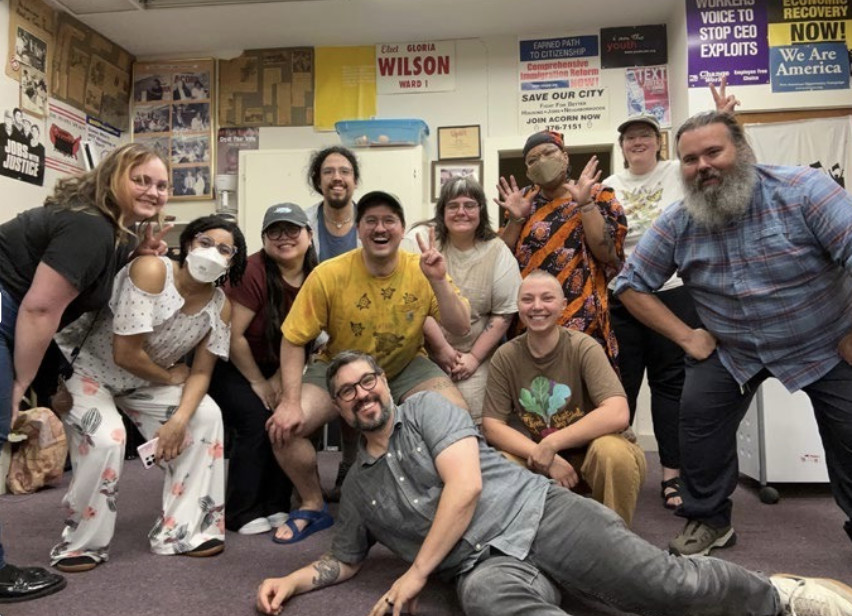
Branch by branch, something new is growing inside the Central Arkansas Library System.
Over the past month, library workers across CALS have been quietly and steadily organizing with United Labor Unions Local 100, and in recent weeks that momentum has accelerated.
Members have now come forward from 9 of CALS’s 15 branches, representing a broad cross-section of the system’s dedicated staff.
“There’s a lot of enthusiasm for the union. For having a voice, for the protection that standing together provides,” said Greg Moore, organizer for ULU Local 100.
This organizing effort isn’t happening in opposition to CALS. It’s happening because library workers believe in the mission of this system and want to see it succeed for the long haul.
That means building a real, working partnership with the Library Board and the Administrative Office, one where staff have a voice when decisions are made about the policies and conditions that shape their daily work.
A stronger, more stable workforce is good for CALS patrons, good for the branches, and good for the system as a whole.
The union is about protecting the CALS librarians as professionals, as the people who do the daily work on the front lines to make the library run.
It will give a voice to issues that matter most to staff, from consistent application of personnel procedures to safety concerns to simply having a clear channel for feedback to be heard.
The goal is a library system where the people who keep it running every day have a real voice in how it’s run.
United Labor Unions Local 100 is proud to stand with CALS staff, and we look forward to working with the administration.
Your Union Stewards are Here to Help
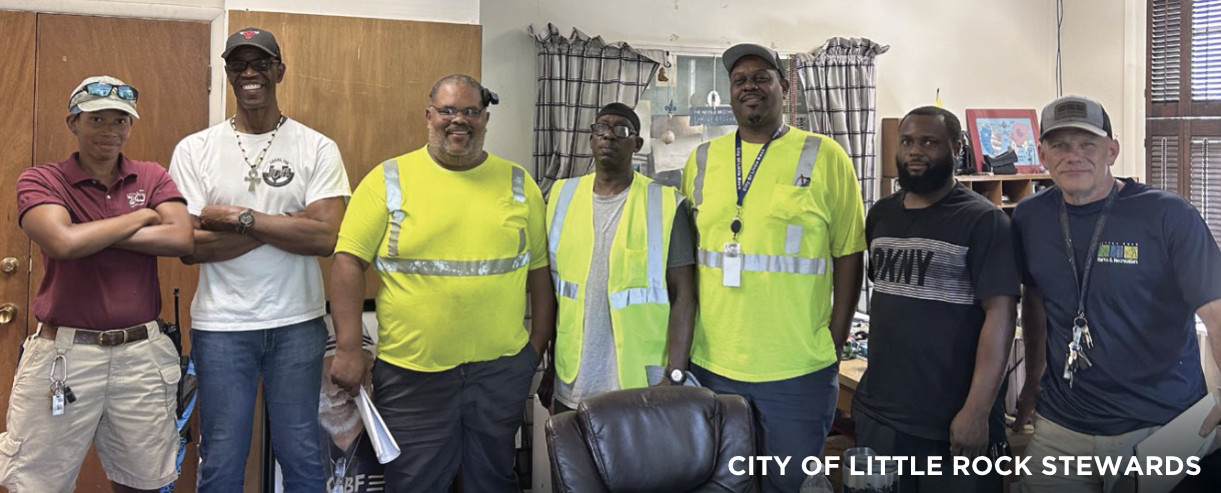
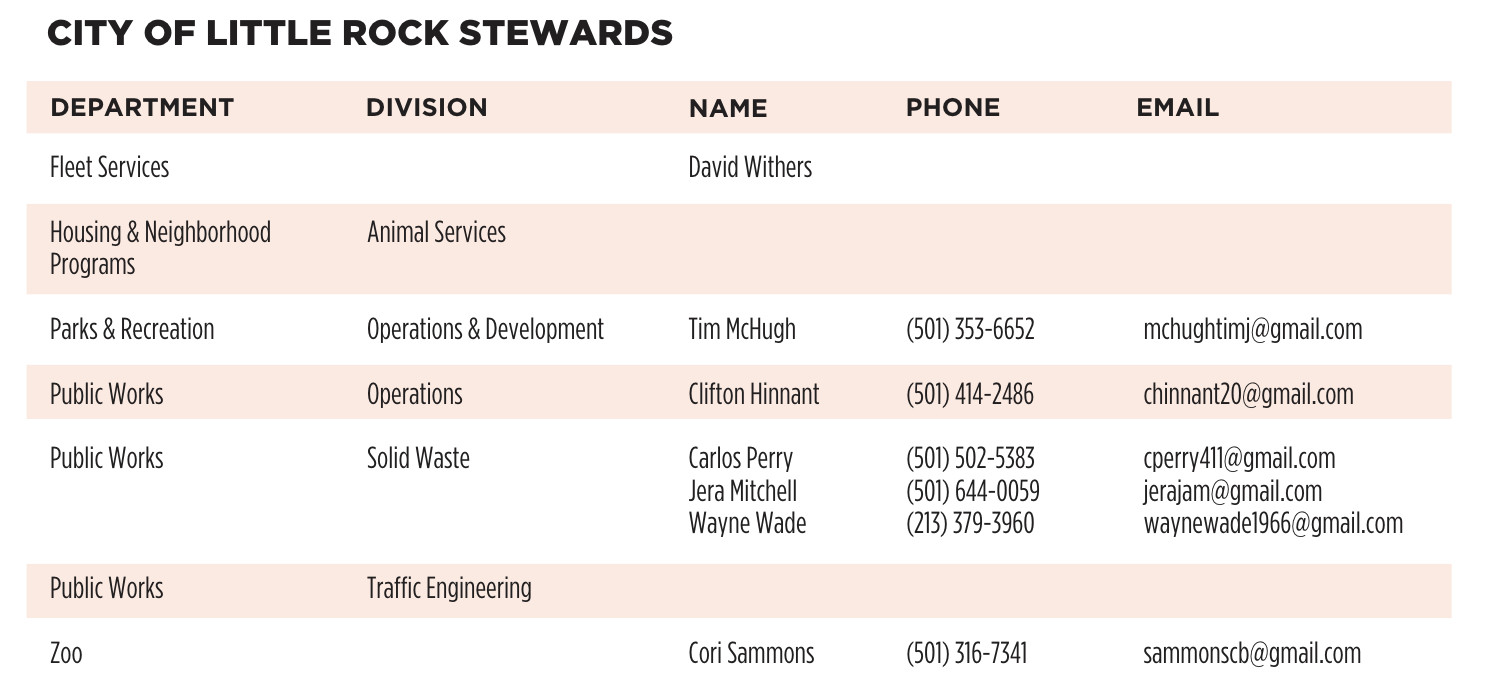
Your union steward is your first point of contact when you have a question, a concern, or a problem at work.
Whether it’s a disciplinary issue, a question about your rights, or just something that doesn’t feel right, your steward is there to listen and help you figure out next steps.
You don’t have to do this alone! That’s what the union is for.
If you are interested in getting trained to be a steward in your department, contact the union!
Did You Know? City of Little Rock Workers Can Use Their Work History to Boost Their Pay!
SUBMIT A RESUME TO APPLY FOR A HIGHER SALARY TODAY
If you work for the City of Little Rock and you’ve been wondering whether there’s anything you can do to move up the pay scale, the answer might already be sitting in your work history.
According to the City of Little Rock’s Compensation Manual, your prior work experience can factor into your salary.
What This Means for You
A detailed resume or work history document that lists your previous employers, job titles, dates, and responsibilities can move you up the steps to a higher pay grade.
Simply submit a resume of your work experience starting with age 18.
Steps to Take Right Now
1. Review the Compensation Manual
The City of Little Rock publishes its pay scales and compensation guidelines online.
2. Build a complete work history
Don’t leave anything out.
List every job you’ve held, including dates of employment and a clear description of your duties.
All of it counts toward your equity score.
3. Make sure you put in your whole work history when applying
When applying through the City’s job portal:
governmentjobs.com/careers/littlerock
include all of your work history.
4. Ask about reclassification
If your job duties have expanded over time but your pay grade hasn’t budged, you may qualify for a reclassification.
Contact HR at (501) 371-4590 to ask about the process.
5. Talk to your union rep
ULU Local 100 is here to help members navigate this process.
If you have questions about your pay grade, your options, or how to document your experience effectively, reach out to us.
If you have questions or want help putting together your work history, contact Local 100 at (501) 247-3869
City of Little Rock Launches New Career Pathway for Traffic Signal Technicians
The City of Little Rock has established a new, standardized career pathway for traffic signal personnel, creating a clear and structured route for advancement while ensuring safe, reliable signal operations across the city.
The program is competency-based, meaning promotions are tied to demonstrated skill and industry certification rather than time alone.
It consists of three progressive positions.
Apprentices spend up to 24 months building foundational knowledge and safety skills before advancing through a written and hands-on exam, along with IMSA Level I certification.
Technician I staff develop independent maintenance and troubleshooting skills over 18 to 36 months, advancing through exams, leadership training, and IMSA Level II certification.
Technician II represents advanced diagnostics, programming, and leadership responsibilities.
Training is self-directed, built around the Traffic Signal Maintenance Handbook (TSMII), 2nd edition, and reinforced through two outside vendor training sessions annually, one IMSA certification class per year, ongoing on-the-job training, and check-ins at least every six months.
Employees who maintain a valid Commercial Driver’s License are also eligible for a $3,000 annual incentive payment.
This pathway ensures traffic signal workers are properly compensated for their expertise and gives them a real avenue for advancement.
Local 100 is excited to work with the City to develop similar career pathways in other departments.
From the Field Director’s Desk
ULU Local 100 Field Director Toney Orr

One question I hear often is: What is the union doing for me?
My answer is always the same — I ask it right back: what are you doing for the union?
It’s been ten months since Local 100 took over representation of the City, and change has never been easy.
In the beginning, it felt like running around like a chicken with its head cut off!
We kept trying to plug leak after leak left behind by years of miscommunication, misunderstanding, and, at times, a lack of cooperation from the city.
I’m grateful to the members and stewards who helped us get through those first months.
Now we’re starting to level out, and we’re seeing real progress — not just in wages, but in policy changes, in the compensation and equity studies, in a new seniority policy, and in holding management accountable to the goals we set at our first bargaining session.
Does that mean we’re satisfied? No.
Does it mean we’re complacent? No.
There is still so much work ahead, and changing a culture takes time.
But it is happening.
None of this would exist without the employees who first came to us wanting something different.
Andrew Brewer, Carlos Perry, Kashanda Perry, Curtis Cunningham, Justin Marin, David Withers, Karla Parker, and Helen Peaster made up our original negotiating team for the City of Little Rock, and their hard work opened the door not just for our city members, but for the momentum we’ve since built with the Central Arkansas Library System and beyond.
Going forward, you’ll see this newsletter every month, along with suggestion boxes and a Member of the Month feature.
We’re also working with our stewards to lock in a regular time for monthly membership meetings, so stay tuned and keep the questions coming!
TUESDAY, AUGUST 11 / 6PM 2101 S. Main St. Little Rock